
When Shabbat went out on Saturday night, I turned on my phone and found what everyone else in Israeli media found: Ro Khanna – a congressman from California – telling two million people that Israeli settlers with American-made M4s detained him in Judea and Samaria (the West Bank), and that when the IDF showed up, the soldiers sided with the settlers and kept him there.
My first reaction was anger at the men who blocked that road. It still is.
Something did happen on Wednesday near Khirbet Zanuta. Armed young men surrounded a minibus carrying a sitting member of Congress, kicked its tires, cursed at the passengers, filmed them, and laughed at them, and kept the road blocked for over an hour while a New York Times photographer sat inside watching.
The same week, four suspects were arrested for attacking a CNN crew near Sinjil with clubs. I have no idea who these men think they’re protecting. They handed Israel’s harshest critics a gift no BDS campaign could have bought. The IDF itself called the blocking unlawful, and the only serious response is to prosecute them.
So why am I writing this column? Because I spent Saturday night reading everything published on this story, in English and in Hebrew, and the version Khanna is telling America has grown in the telling.
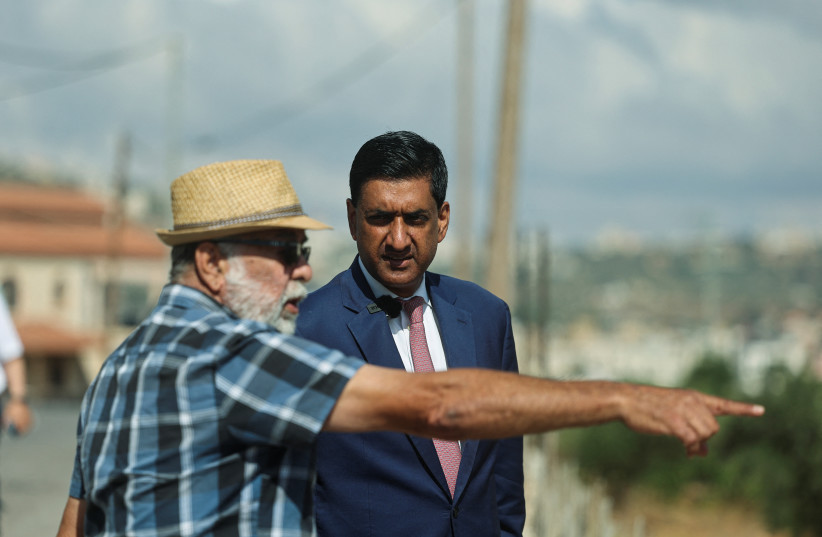
He told Reuters, twice in one sentence, that the men had machine guns. The M4 is a carbine. A small thing, maybe, from a politician who demands precision about every bomb Israel drops. The bigger problem is that the IDF statement said it is reviewing the identity of “the armed individual.” Singular. The army’s account has one armed man. His tweet has settlers, plural, brandishing rifles. Somebody’s description is wrong, and it can be checked.
Khanna's story ends four different ways
Then there’s the ending, or rather the endings. His tweet said the IDF continued his detention. His own aide told reporters they were released when officers showed up. Khanna told CNN they were freed after the embassy reached a senior Israeli official. Haaretz reported it was the Foreign Ministry. The army said its troops cleared the road. I’ve read four accounts of how this ended, and Israelis get him out in all of them.
By Saturday night, an American news headline said he was detained by the IDF, and the men who actually blocked the road had disappeared from the story.
There’s also a question nobody in the American coverage has pressed. Khanna said the Israeli government was notified of his trip. An Israeli security source said the visit was never coordinated, which is why he had no security. Those are two different claims.
Remember, this was a tour of Judea and Samaria exclusively, with programming built entirely by Palestinian hosts, by a man who declared before boarding the van that anyone unwilling to say “genocide” and “apartheid” is morally compromised, three weeks after signing a pledge committing him to those exact positions, and who told the Times it is not a good idea to detain long-shot presidential candidates. He knows what Wednesday is worth to him.
IDF must review soldiers' behavior
I wish I could stop there. I can’t, because his inflated version works only where the true version embarrasses us. The Times witness described soldiers who stood around, chatted with the men blocking the road, and smoked. If that’s accurate, the IDF should say so, discipline them, and move on, instead of letting the account stand uncontested.
Meanwhile, the prime minister goes on CNN and calls settler violence exaggerated, the work of 150 juvenile delinquents. Maybe so. This country found its enemies in Tehran; it can find 150 hooligans in Mount Hebron if it wants to, and as long as it doesn’t, every ambitious American politician with a van and a camera crew knows exactly where to go.
Khanna said we’ll be hearing more soon. I hope some of it happens here. The Jerusalem Post studio is open to him, on the record, for as long as he wants, with the IDF statement and his own timeline on the table. He came for an unfiltered look at us. He’s welcome to an unfiltered interview with me. If his story holds up, he has nothing to worry about.