
In a recent interview I gave to the Lebanese journalist Maria Maalouf, I argued that the Quran can be read as a Zionist document. This claim caused quite a stir, yet it built a crucial bridge between Zionism and Islam, which is essential for establishing peace in our region.
On the most fundamental level, Zionism seeks to answer two questions: What is the land of the Jews, and to whom does the Land of Israel belong?
The Zionist answer, of course, is that the Jews belong to the Land of Israel, their historical home and motherland, and that the land belongs to them: not only by virtue of a religious promise, but also due to the historical right of an indigenous people to their homeland.
Although loud and aggressive voices create the impression of an absolute frontal clash between the Zionist vision and Islam, a reading of the Quran reveals a surprising agreement between Zionism and Islam on these two foundational issues.
The Quran itself recognizes the Children of Israel’s right to their land. It states explicitly, through the words of Moses (peace be upon him), who is recognized as a central and important prophet in Islam: “O my people, enter the Holy Land which Allah has assigned to you and do not turn back [from fighting in Allah’s cause] and [thus] become losers” (Surah Al-Ma’idah 5:21).

Likewise, the promise of the Children of Israel’s return to their land appears as a divine promise: “And we said after Pharaoh to the Children of Israel, ‘Dwell in the land, and when there comes the promise of the hereafter, we will bring you forth in [one] gathering’” (Surah Al-Isra 17:104).
What the Quran says about the connection between Jews and Zion
Thus, the Quran can be read as a text that confirms the first covenant and the Children of Israel’s right to the Land of Israel.
What is the place of the Children of Israel? The Quran agrees with Zionism that they must be in the Land of Israel.
To whom does the Land of Israel belong? The Quran answers in a verse directed at the Children of Israel: “The Holy Land which Allah has assigned to you.”
At the very least, the Quran makes it impossible to honestly claim that the Jewish connection to the Holy Land is foreign to Islam.
So on this issue too, there is an agreement between the Quran and Zionism. It is astonishing to see how Quranic commentators from extremist Islamic schools of thought evade these verses, despite their unequivocal nature.
We could sum up the matter here and determine that these verses alone are enough to establish a practical agreement between Zionism and Islam.
Fortunately, however, there are deeper layers for us to explore. For many, Zionism is perceived not merely as an agreement on the right of the Children of Israel to a national home in their historical land, but also as a general affinity or affection for Jews or Israel.
Paradoxically, today, Americans or Europeans who respect the Jews’ right to a national home or are perceived as friendly to Jews are negatively labeled as “Zionists,” usually by individuals identified as Islamists.
Yet the Quran does not settle for merely recognizing the Children of Israel; the Children of Israel are so central to the Quranic narrative that Surah 17 is traditionally known as both Al-Isra and Bani Isra’il.
When delving into a third question: How does the Quran relate to the Jews? A picture emerges that is significantly different from the one portrayed in the media.
The Quran does not reduce Jews to “infidels.” It recognizes them as “Ahl al-Kitab” (People of the Book) – a community possessing revealed scripture and sharing belief in the God of Abraham.
The Quran deals with the history of Moses (peace be upon him) and the Jewish people, not just the history of the Prophet Muhammad (peace be upon him), and defines an attitude of recognizing the Torah as a revelation from God, containing “guidance and light.”
The Quran tells of Jews who came to the Prophet Muhammad (peace be upon him) and asked him to judge between them. Regarding this, the Quran states: “But how is it that they come to you for judgment while they have the Torah, in which is the judgment of Allah?” (Surah Al-Ma’idah 5:43).
In the story of the birth and deeds of Moses (peace be upon him), the Quran notes that Allah chose to empower the oppressed people of Moses: “Indeed, Pharaoh exalted himself in the land and made its people into factions, oppressing a sector among them, slaughtering their [newborn] sons and keeping their females alive.
“Indeed, he was of the corrupters. And we wanted to confer favor upon those who were oppressed in the land, make them leaders, and make them inheritors. And establish them in the land and show Pharaoh and Haman and their soldiers through them that which they had feared” (Surah Al-Qasas 28:4-6).
But in my eyes, perhaps the most important quote that has eluded us in the Quran says: “And do not argue with the people of the scripture except in the best way, except those who commit injustice among them … We believe in what has been revealed to us and what was revealed to you. Our God and your God is one” (Surah Al-’Ankabut 29:46).
Just as in Judaism, the “Love your neighbor as yourself” notion provides a fundamental, one-legged basis for understanding the essence that allows Muslims to coexist alongside Jews, this verse provides a one-legged basis that can allow Jews to coexist alongside Muslims with dignity (if only everyone acted according to these verses).
Beyond the Quran
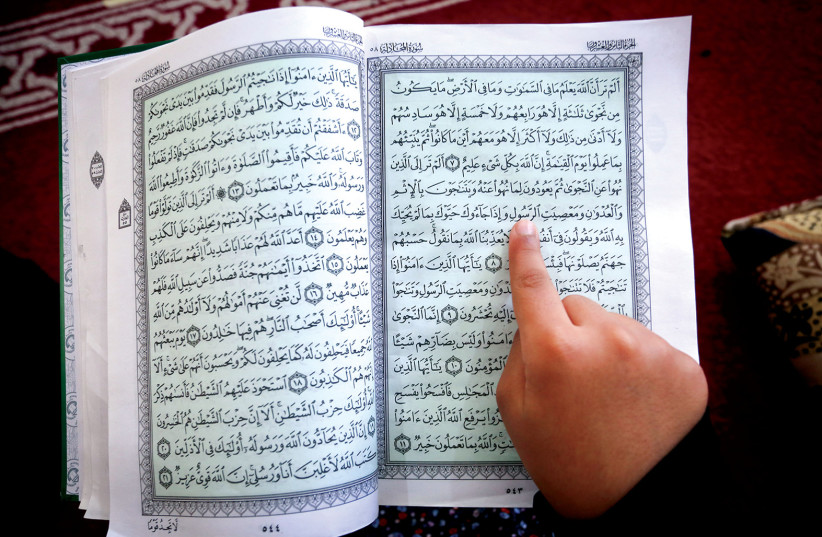
In these verses and many others, the Quran lays a clear foundation for accepting the Children of Israel in general and their return to their land in particular.
But beyond the religious significance and the quoting of important verses, how can we build a shared vision in which all the peoples of the Middle East can take part?
An initial answer to this question has emerged in recent months in Sweida and Khan Yunis. Israel is protecting the Syrian Druze in Sweida from jihadist attacks – a military defense that carries a diplomatic price.
It is the exact same type of backing that would be given to a Jewish Diaspora community located outside Israel’s borders, and it is happening even though the Druze in Syria were historically considered loyal to the Assad regime and were not friendly to Israel.
This path is in its infancy, and many challenges still lie ahead. Still, from a historical perspective, this is a moment that expands Zionism beyond the Jewish people and places the Druze on the table as full partners of the State of Israel – even when they are not its citizens.
This partnership is not limited to the Druze. In an anti-Hamas enclave east of Khan Yunis in Gaza, another experiment is beginning to take shape. Palestinian clans and local organizations that oppose Hamas and choose a vision willing to include Israel as a legitimate and friendly state are receiving Israeli backing.
This allows them to provide their people with security, and even education and a network of social services amidst the madness of Gaza.
The message radiating from these activities to the region is that the door is open, and Israel’s umbrella is not limited to Jews alone. It can expand to encompass partners in this vision. For many, this is a novel idea that could lead to a rethinking of the current paradigm.
However, Zionism is not only the question of a national home for the Jewish people, and in 2026, it is not merely the aerial cover of the IDF.
It is a proven blueprint, the only one of its kind in the world, for the national revival of a refugee people, exiled from its land, who returned and within less than a century lifted themselves from the brink of annihilation to become a hi-tech and agricultural superpower blooming in the desert.
Against the backdrop of the region’s challenges, Moses (peace be upon him) is relevant not only to the future of the Jewish people’s relations with its neighbors, but so are Theodor Herzl and David Ben-Gurion. Many are reading Herzl’s writings in the Middle East in recent years, from Damascus to Tehran, and asking themselves – what can we learn from this?
Thus, one can identify today more and more people in the Middle Eastern public sphere who define themselves as Muslim Zionists, Lebanese Zionists, Iranian Zionists, Alawite Zionists, Kurdish Zionists, and other new formations we have never seen before.
When they testify about themselves as being “Zionists,” they often do not mean solely that they support Israel’s right to exist, based on confirming Quranic verses or for other reasons.
They mean the vision they share with Zionism and the inspiration they draw from it as a doctrine for rebuilding a nation.
They relate to the sense of mission of a people stepping up to build its future; to groundbreaking leadership like that of Ben-Gurion, who set out to make the desert bloom; to a vision like Herzl’s, looking a thousand years into the future; to the way emissaries moved between communities with a new idea, how communities mobilized, and how mechanisms were established overnight to rebuild a shattered nation.
The idea currently passing the test in Sweida and Khan Yunis is that Israel can provide security for its partners.
The greater test will arrive in the near future: Can the Zionist idea provide the necessary blueprint for rebuilding Sweida and Khan Yunis according to the Israeli model, as free (though not necessarily independent) societies, tolerant in nature, and advancing toward prosperity?
If Zionism can pass this test, it will transform from a national idea belonging to a specific nation into an idea of shared national revival and development, capable of taking many peoples under its wings.
The writer is the author of the book The Abrahamic Revolution and is the CEO and co-founder of the Abrahamic Movement.