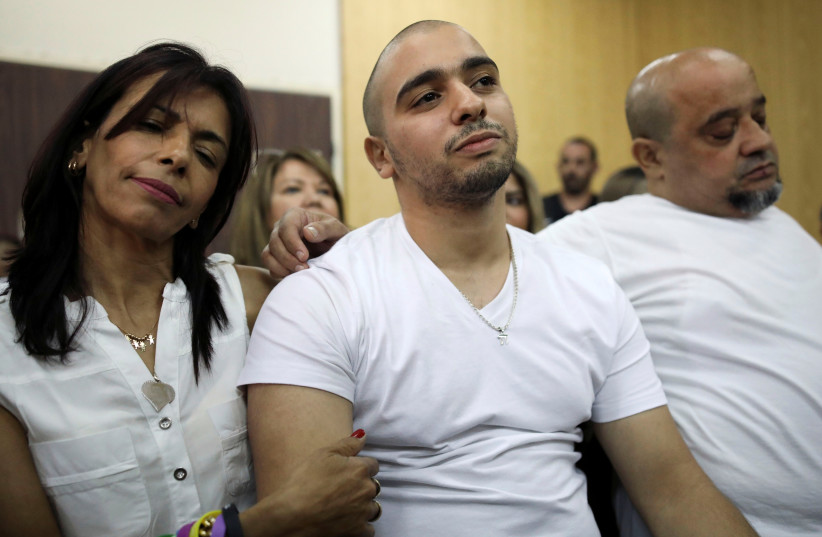
On September 19, President Isaac Herzog cleared the criminal record of former IDF soldier Elor Azaria, closing one of the most divisive cases in recent Israeli history.
But was this simply an act of mercy toward one former soldier, or does it signal a long-overdue change in how Israel treats the young men and women it sends into battle?
I served in the IDF for more than 30 years. During that time, I watched rules of engagement and ethical guidelines intended to preserve the IDF’s morality become a source of hesitation and fear. Soldiers know that a decision made in seconds may be scrutinized for months in a courtroom.
Years of institutional caution contributed to the hesitation and confusion that allowed terrorists to pour across the Gaza border on October 7. The failures that day were many, but the culture in which soldiers have been trained to hesitate was undoubtedly one of them.
The same priorities endangered soldiers during the war in Gaza. To avoid harming civilians, troops were required to enter and search buildings rather than destroy them from a safe distance, even when those buildings were likely to be booby-trapped.
Restraint is not automatically moral. Yet too many senior commanders have publicly defended this mode of operation, placing Israeli soldiers at greater risk to minimize danger to the enemy’s population, as moral leadership.
Former chief of staff Benny Gantz boasted that, on his watch, he did not send Golani soldiers in to take terrorists hiding in a Gaza hospital. Former chief of staff Gadi Eisenkot, today running to lead the country, boasted that he held back a strike on a building in Beirut to kill Hezbollah leaders, instead issuing multiple warnings, and then failing to kill them.
When restraint allows terrorists to escape or transfers greater risk to Israeli soldiers and civilians, it is not moral leadership. An army’s first duty is to defend its country, protect its people, and defeat its enemies.
The Azaria case became the defining example of that distortion.
On March 24, 2016, two Palestinians armed with knives approached an IDF position in Hebron and stabbed an Israeli soldier. Troops opened fire, killing Ramzi Aziz al-Qasrawi and badly wounding Abdel Fattah al-Sharif.
Sgt. Elor Azaria, then a 19-year-old combat medic, arrived with reinforcements. Minutes later, he fired a single shot into al-Sharif’s head. A B’Tselem volunteer filmed the shooting, and the video spread around the world.
Azaria said he had heard warnings that the attacker might be carrying explosives. He pointed to al-Sharif’s heavy coat, his movements, and the nearby knife, and said he believed his fellow soldiers remained in danger. The soldier who had been stabbed testified that he, too, had feared an explosive belt.
The military court rejected Azaria’s explanation and convicted him of manslaughter. He was sentenced to 18 months in prison, later reduced to 14 months, and was released after serving nine.
Reasonable people can continue to disagree about Azaria’s decision. What should concern every Israeli, however, is the message the case sent to soldiers in the field: hesitate, and your friends may be killed; act, and the army, the legal establishment, and the media will turn on you.
The prosecution may have intended to uphold military standards. But to many soldiers and their families, the spectacle of the trial communicated something else. It suggested the system cared more about demonstrating its morality to the world than understanding the impossible decisions demanded of a 19-year-old under operational pressure.
This is what “purity of arms” becomes when enforced without balance: military lawyers, cameras, and international headlines hovering over a soldier’s shoulder as he decides whether to fire.
Herzog’s decision allows Azaria to work, raise his children, and live without the constant burden of a criminal record. That matters. But by itself, it changes nothing for the next 19-year-old soldier forced to make a life-or-death decision.
If the decision is merely an act of mercy in a closed case, the same uncertainty will remain. But if it marks the beginning of a doctrinal shift, it may represent an overdue correction.
Choosing the path forward
Israel does not need to abandon its values. It needs to restore their proper order. Victory, the protection of Israeli civilians, and the protection of our soldiers must be central to the ethical framework.
Military lawyers should help commanders conduct lawful and effective operations, not replace operational judgment with endless process. Soldiers and commanders must know that when they make reasonable decisions in defense of Israeli lives, the country they serve will stand behind them.
The United States has already recognized the danger posed by overly restrictive rules and legal structures and has begun taking steps to address it. US Defense Secretary Pete Hegseth has ordered a review of military legal offices, insisting that military lawyers must enable decisive action rather than paralyze battlefield decision-making. Israel should follow suit.
The groundwork already exists. Maj.-Gen. (res.) Uzi Dayan and Rabbi Oury Cherki have drafted a revised ethical framework that places victory and the protection of Israeli civilians and soldiers at its center. Around 30 members of Knesset have likewise called for the IDF’s ethical code to be rewritten so that its priorities are clear.
The coming election will therefore decide more than the composition of a coalition. It will help determine the doctrine under which the IDF fights.
Will Israelis return power to figures from the old senior command who defend the existing approach? Or will they choose leaders prepared to say, without apology, that the protection of Israelis and Israeli soldiers must come first?
Clearing Azaria’s record closes one file. The ballot will decide whether Israel also closes the chapter on a military culture that has confused hesitation with morality and whether the IDF returns to a distinctly Jewish moral principle: the duty to defend life.
The writer is the host of The Pulse of Israel daily video podcast and CEO of the 12Tribe Films Foundation, which produces media content highlighting Israel’s biblical, historical, and strategic importance to the Jewish people and the world.