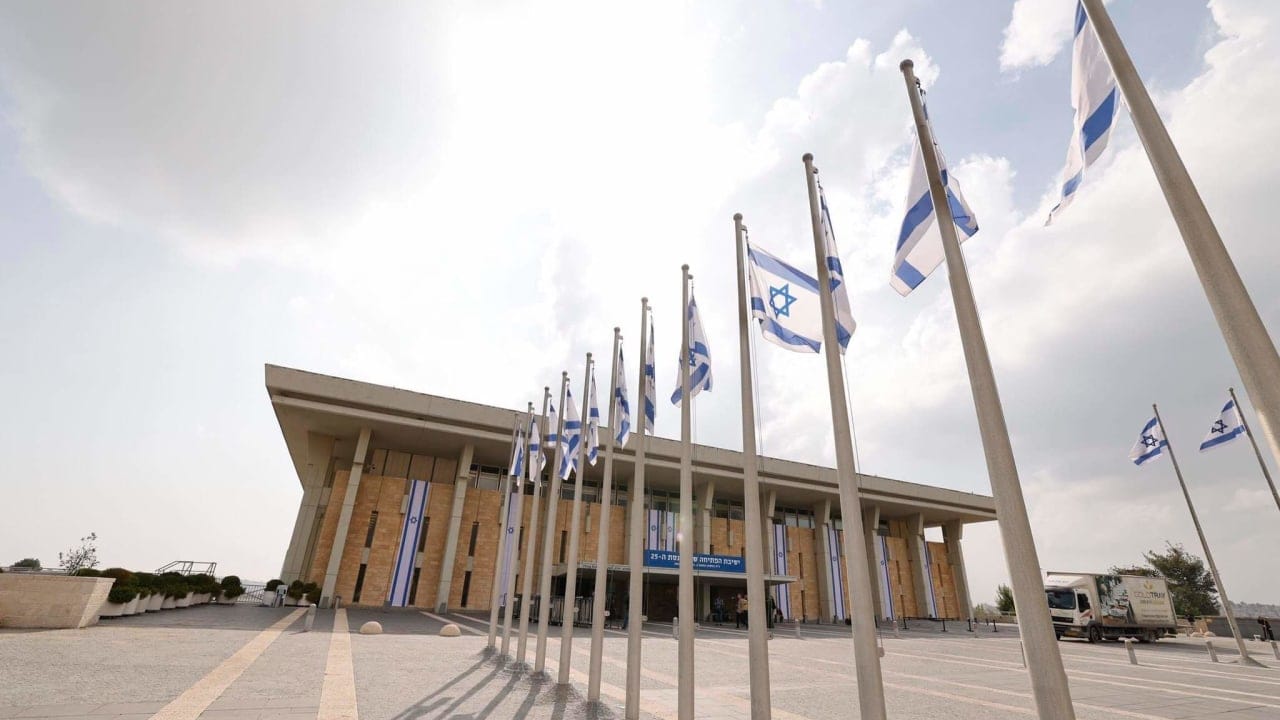
The Knesset elections are over. Perhaps their most significant outcome was the exceptionally high turnout – something Israel has not seen for many decades.
Most democratic countries without compulsory voting laws can only dream of such levels of public participation on election day. Tens of thousands of Israeli citizens living abroad returned to the country in the run-up to the vote to cast their ballots for one political camp or another.
After an election, the losing side usually says: “If only all our supporters had turned out to vote, the result would have been different.” This time, no party or bloc can fall back on that excuse. The election results clearly reflect the reality on the ground and accurately capture the mood of the Israeli public.
It is equally clear that neither the parties in the current coalition nor the opposition bloc can, on their own, claim to represent a majority of the Israeli people.
We saw this during the political crisis of 2019-2022, when five Knesset elections were held over the course of three and a half years. The results of the October 27 election further confirmed this.

Before the election, both the coalition and the opposition promised their supporters a crushing victory over their rivals. I believe that most of those making such promises understood even then that this was impossible: neither side could win 61 seats in the Knesset on its own and thereby secure the ability to form a government independently.
Of course, the country can be taken to a second, third, or even twentieth consecutive election. The same slogans can be repeated, and the supposedly irreconcilable differences between the blocs – differences said to make it impossible for them to serve in the same government – can be invoked again and again.
Will Israel accept the obvious, or continue the cycle of elections
But, as the familiar saying goes, “Insanity is doing the same thing over and over and expecting different results.” The only question is whether we will acknowledge this now or go to the polls several more times before accepting the obvious.
Moreover, even if, in some future round of elections, one bloc were somehow to win a majority or manage to form a minority government with outside support, that would not offer a genuine solution.
Such a government would inevitably be held hostage by marginal, anti-Zionist and anti-state forces: either Itamar Ben-Gvir and the haredim (ultra-Orthodox), or the Democrats and the Arab parties.
What Israel needs is a government of national unity. I have been saying this for a long time. It is the central principle of the platform of Achdut (Unity), the party that Gilad Erdan and I founded. We did not take part in this election, but its results have vindicated our position.
Negotiations to form a national unity government will not be easy. Nor will such a government be – or should it be – a gathering of people who agree on everything. Even with my extensive experience, I would not presume to predict what its final composition might look like or which political forces would join it.
But I am convinced that the familiar “80/80” formula holds true: 80% of Israelis agree with one another on 80% of the issues that matter most to our country.
Israel has a stable Zionist Jewish majority. That gives all responsible political forces a basis on which to come together and work jointly, overcoming the disagreements that will inevitably arise.
What issues do I have in mind when I speak of a broad national consensus? First and foremost, security. We all understand that this is an objective challenge that must be addressed regardless of who is in power.
As Hamas demonstrated on October 7, our enemies do not care which party any of us votes for. The same is true of Iran, which dreams of wiping out the despised “Zionist entity” in its entirety, Left and Right alike.
Israel's economic and cost-of-living crisis
It is equally clear that Israel must tackle its long-accumulated economic problems, curb rising prices and address the ever-increasing cost of living. None of this can wait while rival blocs spend months and years fighting one another for the coveted parliamentary majority.
Israel finds itself in a difficult international position. It is no secret that many forces – even in countries we have traditionally regarded as allies – are pushing to isolate us and calling for boycotts and sanctions.
Engagement with the outside world is also far more effective when you can be confident that the government behind you is not a fragile administration riven by internal conflict, but a united government representing the majority of the country’s citizens.
Finally, I cannot overlook the need for a new, fair conscription law, which I fought hard to advance when I chaired the Knesset Foreign Affairs and Defense Committee.
This issue is long overdue for resolution. It is eating away at Israeli society from within and holds the key to addressing many of our security and economic challenges.
Unfortunately, my efforts to pass such a law failed to win support. The Zionist members of the current coalition were unwilling to stand up to their coalition partners in defense of their principles, while the opposition saw the bill as a battering ram with which to destabilize and bring down the government.
We must break with the prevailing political paradigm and abandon entrenched stereotypes. The logic of confrontation must give way to the logic of solidarity. That requires a change in dominant patterns of political behavior – and in political language itself.
Rather than dwelling on disagreements, often over narrow or secondary issues, we must look for common ground, even when doing so is difficult. Politicians must stop telling voters: “We will not sit with these people, we will not join a government with those people, and we will never vote alongside the others.”
Such declarations only deepen the divisions and fuel confrontation within Israeli society. Genuine responsibility and true leadership mean promising voters that you will seek partners across the political spectrum among all those who belong to that “80/80” majority – and then keeping that promise.
The era of campaign slogans and petty infighting must come to an end. It is time to seek bold, unconventional solutions – solutions shaped not by narrow party interests, but by the interests of the nation as a whole.
The writer served as speaker of the Knesset and as a minister in several Israeli governments.