
An asteroid around the size of 38 Lubavitcher Rebbes is set to pass the Earth on Thursday, June 18, which is the anniversary of the Rebbe's death, according to NASA's asteroid tracker.
The asteroid in question has been designated 2003 LN6, and is set to fly past the planet at a distance of a little over 1.4 million kilometers, according to the Center for Near-Earth Object Studies (CNEOS) at NASA's Jet Propulsion Laboratory (JPL).
The relatively close - but safe - flyby will occur during the yahrzeit of Rabbi Menachem Mendel Schneerson, the famed leader of the hassidic Lubavitch sect and the founder of the global Chabad movement.
The Asteroid Rebbe? How big is the asteroid heading for Earth?
Asteroid 2003 LN6 has an estimated diameter of as much as 67 meters, according to NASA's calculations.
But why count all of that when we can instead make a timely reference to one of the most influential Jewish religious leaders of the modern era?
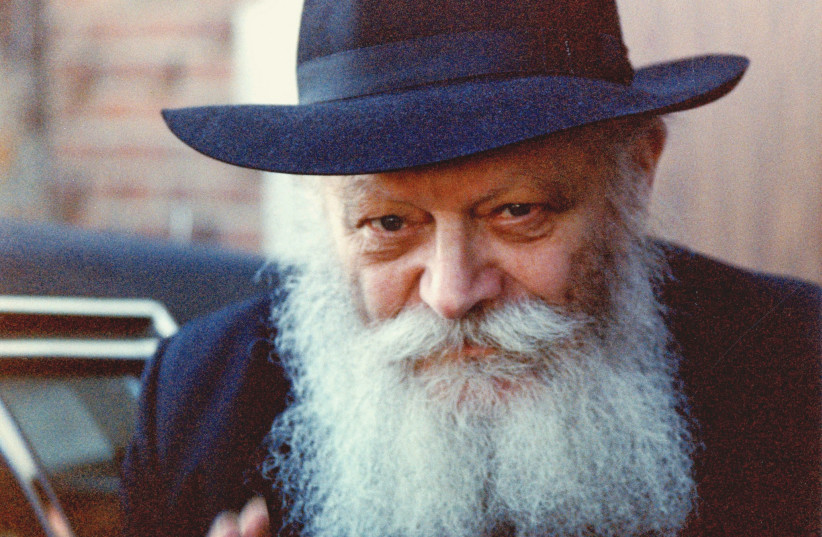
Yes, I am referring to the Lubavitcher Rebbe himself, Menachem Mendel Schneerson.
While he is often referred to as a giant of Torah and Judaism, his physical size was far more realistic.
According to records from the Rebbe's 1941 arrival in the United States by way of the Portuguese ship SS Serpa Pinto to Ellis Island, the man himself stood at a height of five feet, nine inches.
Now we normally like to do these calculations to appease the metrically-challenged readers, but this time we will do so for the metrically-inclined. Five foot nine inches is roughly 1.75 meters.
Now the fun part, imagining how many Rebbes can we fit inside the diameter of an asteroid. The answer is approximately 38.
Unfortunately, the result didn't come out to any of the more significant Chabad numbers like 770.
However, if one were to look at chapter 38 of the Tanya, the text that embodies the core of Chabad philosophy and authored by one of the previous Lubavitcher rebbes, we see the following quote:
"[For] even the material body, and furthermore, even the very stones and earth which are absolutely inanimate - has within it light and vitality from God, so that it should not revert to naught and nothingness as it was."
The interpretation of this is that even inanimate beings, such as asteroids, have a divine life force maintaining its existence.
Scientifically, this pairs well with the fact that asteroids are essentially made of the same materials as Earth - both formed of the space dust and minerals from the birth of the Solar System. The origins of the Earth, and all life on it, are in a sense tied to the origins of asteroids.
Adoneinu, moreinu, ve-asteroid: Will asteroid 2003 LN6 hit the Earth?
It should be noted that asteroid 2003 LN6's orbit will take it closer to the Earth than what is normal for most asteroids. However, at a distance of over one million kilometers, it still won't be close enough to cause any danger.
For context, the Moon is much closer at around 387,000 kilometers. So while the words of the Rebbe may be close to the hearts of the untold masses of Jews around the world, the asteroid I am measuring using him will be far off.
The Messiasteroid: How can the Earth be protected from asteroids?
Is the Lubavitcher Rebbe the Messiah? Does Chabad think that he was the Messiah?
Officially the answer to both is no, though there are some within the Chabad movement that hold this belief. Regardless, the idea of the Messiah as the redeemer who will save the world is an important one in many hassidic movements.
But who will protect the world from asteroids?
We may not have a Messiah now, but we do have something else: scientists.
Those working in the field of planetary defense have been hard at work developing ways to monitor asteroids in space and predicting any that could pose a danger to the planet. Some methods have even been put forward to prevent a potential asteroid attack. One such method, that of kinetic deflection, was even put to the test with NASA's Double Asteroid Redirection Test (DART) Mission.
So while the Messiah may not be here yet to save the world, scientists can at least make sure the world is still around for when he does come.