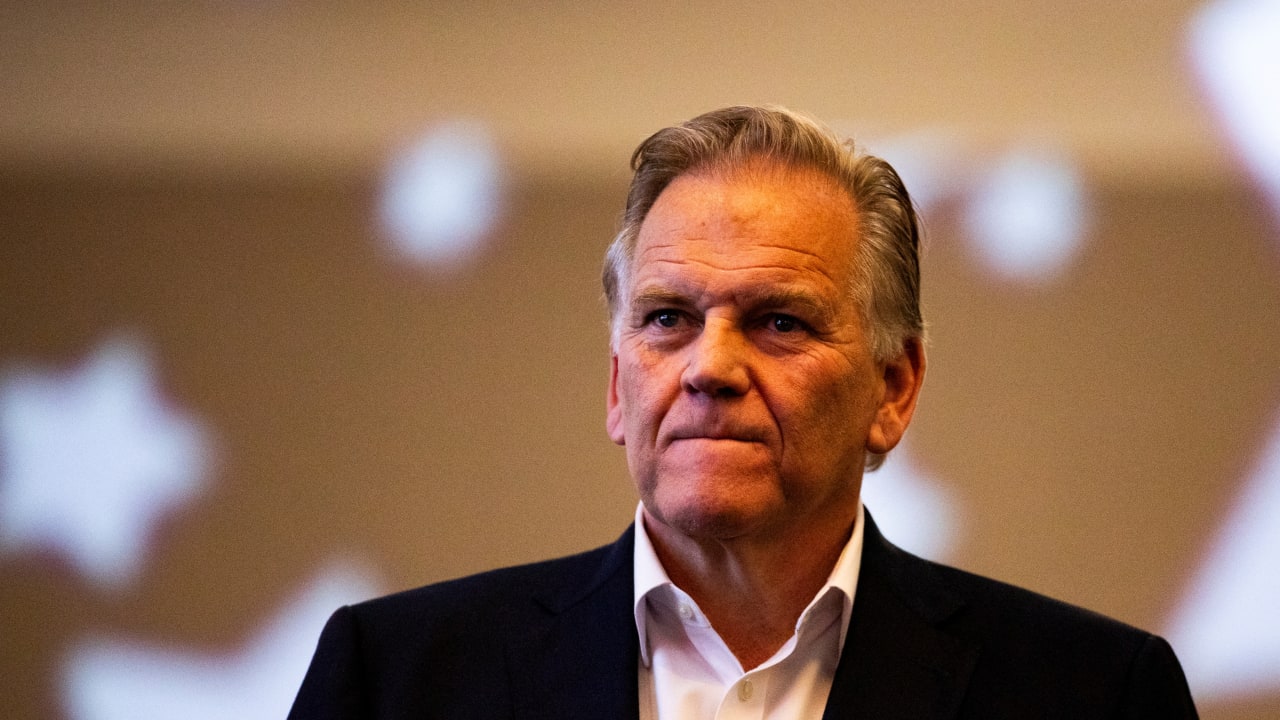
In the weeks since progressive Israel critic Abdul El-Sayed won the Democratic primary in Michigan’s US Senate race, many Jewish and pro-Israel constituencies in the state and beyond are lining up - sometimes reluctantly - for his Republican opponent.
But recent reports have cast doubt on how much support the GOP candidate, former US Rep. Mike Rogers, is comfortable receiving from pro-Israel donors.
According to multiple outlets, Rogers and his representatives have signaled to AIPAC that they would like the pro-Israel lobbying giant to refrain from directly spending in his favor in the general election in order to avoid opening up a line of attack against the candidate, with whom El-Sayed is currently polling in a statistical tie. The campaign is instead suggesting alternative avenues of support, including funneling cash into a general pro-Rogers super PAC.
Rogers did not respond to a Jewish Telegraphic Agency request for comment. And there is no sign the Rogers campaign has cut off relationships with AIPAC, its aligned super PACs, or their donor class. Far from it: Rogers recently attended several major AIPAC-connected fundraisers in Los Angeles, according to the New York Times.
In addition, the vast majority of AIPAC-aligned Jewish donors to his campaign remain in his corner, according to Dennis Bernard, a Jewish resident of metro Detroit and political fundraiser who has said he will support Rogers.

Political climate leads candidates of both parties to turn away from Israel
Nevertheless, Rogers’ reported request - which intermediaries would have to make in a way that circumvents campaign finance laws forbidding direct coordination with super PACs - underscores a growing fear among Jewish and pro-Israel groups.
In a political climate that has seen both parties turn away from Israel and AIPAC to varying degrees, more and more pro-Israel Jews say their most visible player in the political arena may have become more of a liability than an asset.
Bernard, who serves as national chair of government relations for the nonpartisan umbrella group Jewish Federations of North America, described Rogers’ maneuvering around AIPAC as “a tactical strategy.”
“I’m sure Mike is very grateful for AIPAC’s assistance and is not trying to turn down AIPAC money,” Bernard, who has connected several AIPAC-aligned Jewish donors to the Rogers campaign in his personal capacity, told JTA. “Mike’s trying to figure out with everybody else right now: In this changing world, how do you strategically take Jewish money?”
Bernard acknowledged that being linked to AIPAC has become a political liability in many races, regarded by its critics as similar to taking “data center money.”
Reached for comment, an AIPAC spokesperson directed JTA to remarks the organization gave to the Times on Monday.
“The Rogers campaign has been explicit with us that they welcome support from AIPAC and our members,” spokesperson Deryn Sousa told the Times.
AIPAC rarely involves itself in general elections, but the group has stated it continues to see El-Sayed as a prime target.
David Victor, a Michigan resident and former AIPAC president who remains involved in the group, referred a reporter asking about the race to the national group.
There’s no guarantee that a less visible role for AIPAC would protect Rogers, a vocal Israel supporter, from accusations that he is in league with the group. In addition, from the lobby’s perspective, allowing others to spend money raised by AIPAC would deprive the group of both messaging control as well as the opportunity to take credit for what it hopes will be an El-Sayed defeat.
El-Sayed, a former county health official, made AIPAC’s heavy spending in favor of his inter-party rival Rep. Haley Stevens a major talking point on the campaign trail. Many other progressive candidates this election cycle have prevailed while turning AIPAC into a target.
AIPAC and its defenders have argued that its spending for Stevens - which exceeded $30 million - helped narrow El-Sayed’s margin of victory and weakened him in the general election. But the group has taken heavy criticism this electoral cycle, including from ideological allies, over its aggressive spending against some liberal pro-Israel candidates, which observers believe helped propel figures more hostile to Israel into office.
Rogers aims to peel voters away from El-Sayed
Even amid his reported desire to lower the visibility of AIPAC spending in the race, Rogers has been showing signs of hoping to peel Jewish voters away from El-Sayed.
For one, he has taken on some liberal Jewish campaign surrogates. Rabbi Asher Lopatin, who leads the Modern Orthodox congregation Kehillat Etz Chayim in the Detroit suburb of Huntington Woods, spoke at a “Democrats for Mike” press conference last week while standing next to Rogers.
The former director of Community Relations at the Jewish Federation of Greater Ann Arbor, Lopatin, told the crowd that he, a regular Democratic voter, was backing Rogers because El-Sayed “has shown contempt for the Jewish community and, frankly, for American values.”
The rabbi cited El-Sayed’s comments after a man rammed an explosive-laden pickup truck into Temple Israel in West Bloomfield earlier this year. On that occasion, El-Sayed, speaking of the attacker who had lost family in an Israeli strike in Lebanon, said, “Hurt people do hurt people.”
Lopatin also cited the candidate’s relationship with far-left anti-Israel streamer Hasan Piker, with whom El-Sayed had campaigned during the primary. Days after their press conference, El-Sayed distanced himself from Piker following new comments from the streamer that prompted blowback from the Jewish community.
El-Sayed did not respond to a JTA request for comment.
Lopatin told JTA he spoke at the Rogers event “as an individual,” and said that other Jews in the community had thanked him for “speaking up for us.”
Lopatin said Rogers’ reported unease about AIPAC would not affect his support for the candidate.
“Good for him. There’s plenty of Republican money,” the rabbi, who has no affiliation with AIPAC himself, said. “If I were recommending something, I would say, ‘AIPAC, stay out of this race. You’ve done what you could do. Stay out. Let him run.’”
Rogers is also positioning himself as a fighter of antisemitism, and his rival as a driver of it. Addressing the Michigan GOP nominating convention on Saturday, Rogers said he would support Jewish constituents whom he said would be harmed by El-Sayed.
Calling Piker the candidate’s “running mate,” Rogers said the duo’s rhetoric “has real implications” for people like a “young Jewish girl who attends the University of Michigan.” Rogers said the unnamed student told him she “hides her Star of David necklace so that violent antisemites on campus don’t see it and harass her - or worse.”
For his part, Bernard, who also runs a financial advisory firm, said it sometimes makes good business sense “not to take credit for a victory.”
“We let the client or someone else take it, and we just take our big profit and move on,” he said. “Because the people who need to know, know.”