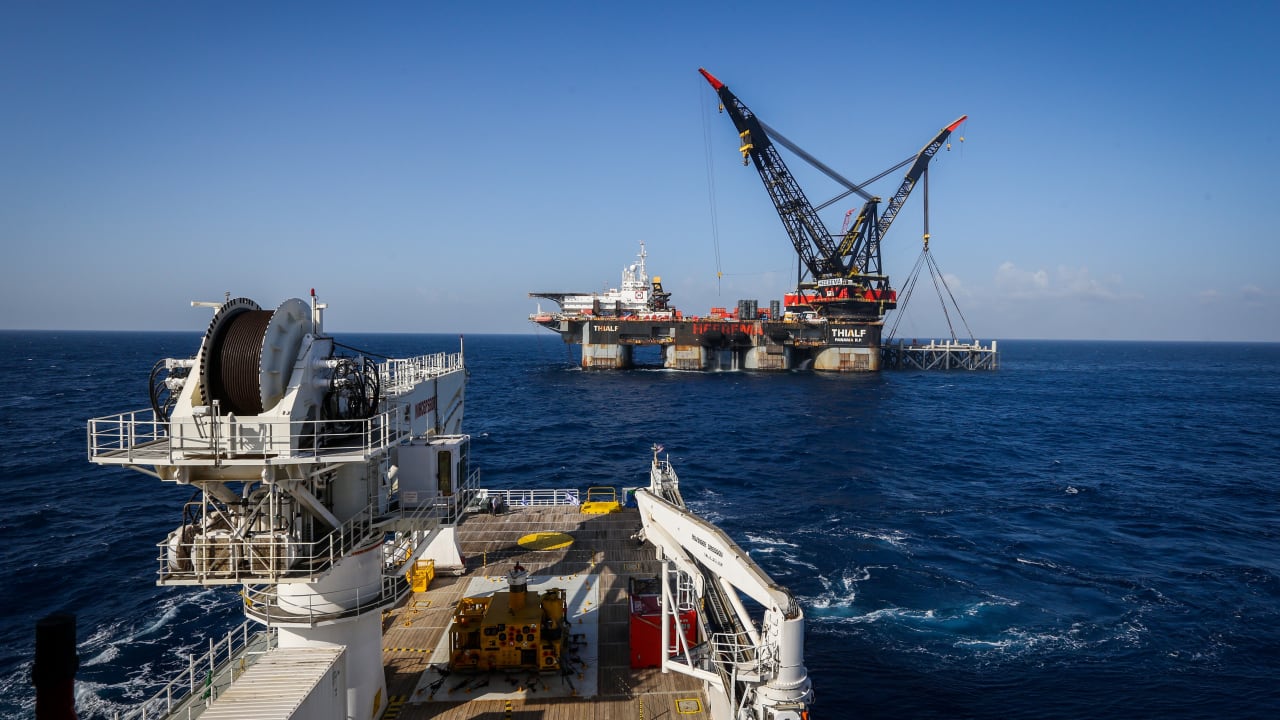
Israel is launching a new competitive process to search for more natural gas in the country’s economic waters, Energy and Infrastructure Minister Eli Cohen said on Monday.
As part of this, Israel will open five new blocks for exploration, covering an area of approximately 7,100 sq.km., the ministry said.
Ministry estimates indicate that hundreds of billions of cubic meters (BCM) of natural gas may remain undiscovered in the sea within Israel’s exclusive economic zone.
Discovering this could help ensure the needs of the local Israeli market are met, increase competition, increase state revenues, and lower Israelis’ electricity tariffs, the ministry said.
Israel has gained over NIS 30 b. from direct gas revenues so far, and is expected to reach hundreds of billions of shekels within 30 years, the ministry forecasted.
Energy minister: 'Natural gas is strategic asset, strengthens Israel's economic, diplomatic standing'
“Natural gas is a strategic asset that strengthens our economic and diplomatic standing in the world in general, and in the Middle East in particular,” Cohen said.
“Therefore, my policy is to expand natural gas exploration, bring international energy giants to invest in Israel, and increase natural gas production, for the local market and for export,” he added.
Six exploration licenses were granted to a group that includes the State Oil Company of the Republic of Azerbaijan (SOCAR), London-headquartered BP, and Israel’s NewMed Energy, the ministry confirmed.
Seismic survey activity will be carried out in the coming months as part of these licenses, alongside the expansion of production capacity from the Tamar and Leviathan reservoirs and the signing of the largest natural gas export deal in Israel’s history, the ministry added.
The deal mentioned will include exporting gas to Egypt, valued at NIS 112 b., of which NIS 58 b. will be revenue for the state, the ministry clarified.
The deal also contributes to regional stability by strengthening bilateral ties with Egypt and creating mechanisms that will encourage additional companies to invest in Israel by setting attractive prices and ensuring that domestic electricity tariffs remain low.
“The ministry is acting to ensure the supply of natural gas to the local market, while maintaining an attractive environment for investments and competitive prices,” Energy and Infrastructure Ministry Director-General Yossi Dayan said.
“The competitive procedure is intended to increase the supply of natural gas, increase competition, attract additional players, and assist in the continued development of the market. The correct way to ensure competition and reduce prices is through expanding supply, and not through burdensome regulation,” Dayan added.
“Alongside its contribution to the market, the procedure will strengthen Israel’s energy resilience and its regional and international standing for the coming years,” he concluded.
The Energy and Infrastructure Ministry’s Natural Resources Administration Director, Chen Bar Yosef, added: “The procedure will enable new and significant entrepreneurs to take part in the development of the Israeli natural gas sector and in the regional energy map. As we have already seen in the past, activity in Israel holds significant potential for success. We intend to act with every relevant international factor and encourage it to submit a bid as part of this important procedure.”

Israel intends to establish one of world's largest underwater power cables, Energy Ministry announces
Meanwhile, the Energy and Infrastructure Ministry has announced plans to implement a “massive infrastructure project” to transmit electricity via an underwater power cable, the ministry said on its Arabic-language X/Twitter account on Monday.
This project aims to “address the growing congestion in the energy transmission network between the South and the center of Israel,” according to the ministry.
It involves laying a cable approximately 150 km. long, of which approximately 102 km. would be underwater to transmit up to 5.4 gigawatts of electricity, making it one of the largest underwater power transmission cables in the world, the ministry noted.
According to the ministry, the idea arose from the concentration of Israel’s electricity production infrastructure, especially solar energy, in southern Israel, while the majority of consumption is in the center. Further, limited land availability would make it difficult to construct a land-based transmission line, the ministry noted.
The planned cable will extend from near Ashkelon to near Haifa, with six connection points to the land-based electric grid, the ministry said.
There are also plans to establish a future connection point towards Europe to enhance electrical connectivity, the ministry added.
The Energy and Infrastructure Ministry views the cable project as “increasing reliance on renewable energy, bolstering energy security, improving grid reliability, and reducing environmental impacts compared to traditional land-based transmission lines,” it said.
Reuters contributed to this report.