
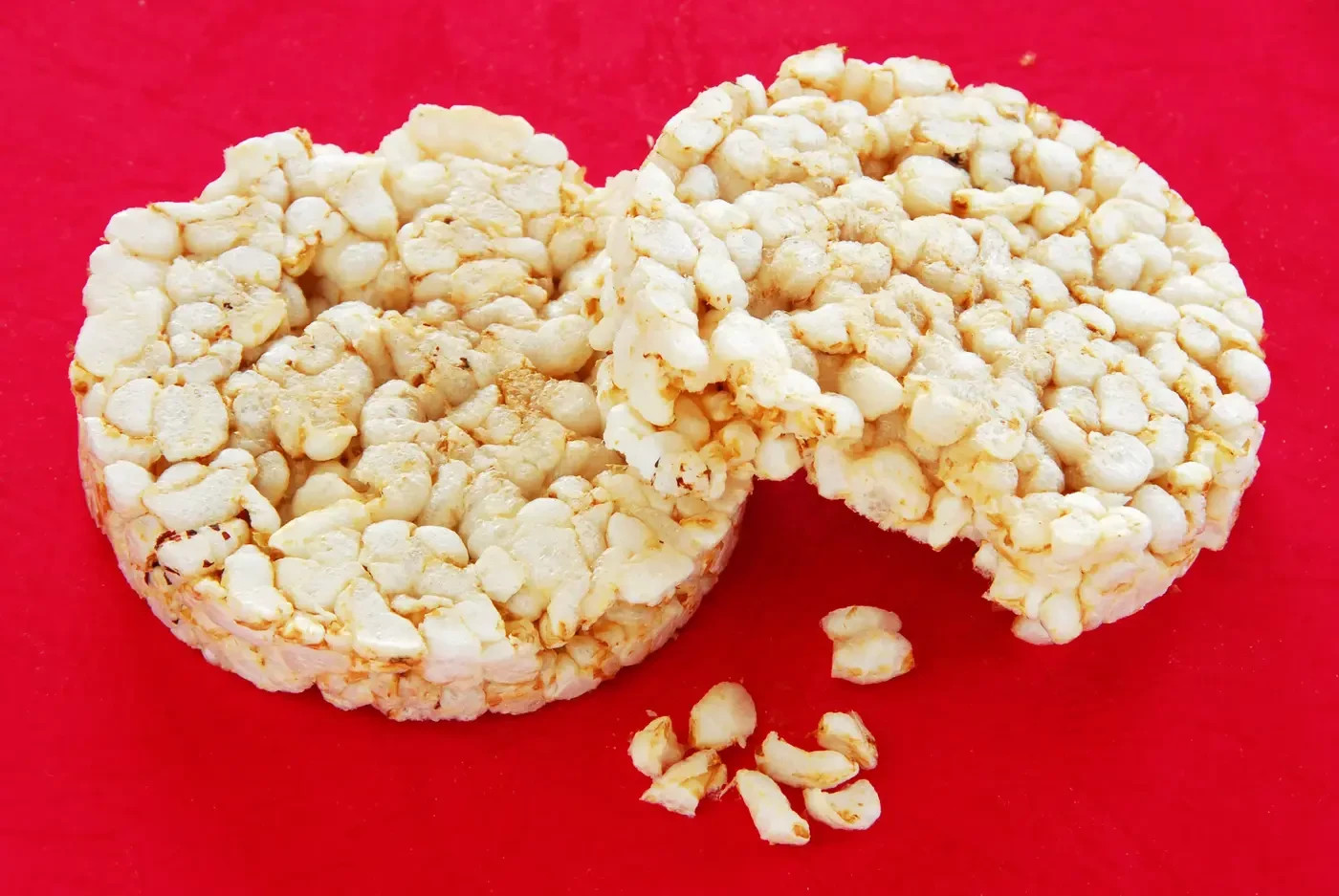
Rice cakes are considered by most of us to be a diet product. A single unit contains very few calories, so it is easy to conclude that they are light, healthy, and suitable for any weight loss menu. But, how many calories are in a unit of something – This is not the metric to determine whether it is dietary. The right question is how many calories are in a hundred grams of the product, because that is what allows for a fair comparison between foods.
If one unit of Bamba contains 3 calories, or if a single almond contains 8 calories, that doesn't make Bamba or almonds a diet product. Also, if a single unit of potato snack has few calories, that doesn't make it healthy.
The exact same principle applies to rice cakes. When checking per hundred grams, it turns out that rice cakes contain an average of about 360 calories, compared to about 180 calories in a hundred grams of light bread. That is, double. The reason they feel light is that they are full of air, and each unit weighs very little. But air, as is known, is not filling.
The figure you are unaware of
If the figure of calories per hundred grams is already surprising, there is another figure that many people who eat rice cakes every day are unaware of: Rice cakes usually have a high glycemic index.
In the manufacturing process, the grain kernels are exposed to heat and pressure, which cause them to puff up and alter the starch structure. As a result, the starch becomes more available for rapid digestion. The exact value varies between rice, corn, buckwheat, and legume cakes, so it is impossible to give a single number that fits all types.
It is important to distinguish between glycemic index and glycemic load. The index describes how quickly carbohydrates may raise blood sugar levels, while the glycemic load also takes into account the amount of carbohydrates actually eaten. A single rice cake can have a high glycemic index, but it weighs little and therefore its glycemic load is not large. When eating several rice cakes in a row, the amount of carbohydrates accumulates.
When rice cakes are eaten alone, they may digest quickly and satisfy for a relatively short time. For some people, this can cause a quicker return of the feeling of hunger.
The way of eating also makes a difference. Rice cakes eaten with cheese, egg, tahini, hummus, or vegetables will have a different effect than rice cakes eaten alone, because protein, fat, and fiber slow down gastric emptying and the rate of digestion.
The comparison test
To get a fair picture, it is worth comparing not unit against unit, but portion against portion with the same amount of calories.
Two slices of light bread contain about 90 calories, and the same amount of calories is obtained from three to four whole rice cakes. But the nutritional composition between these two portions is very different.
In two slices of light bread, there are about 4 grams of protein and about 5 grams of fiber, while the 3–4 rice cakes contain only about 2 grams of protein and only about 1 gram of fiber.
In practice, this means that rice cakes are less filling, both because of the low fiber content per serving, and because of the high glycemic index described above.
Which type of rice cake is preferable?
There is one point where rice cakes actually win, and that is the manufacturing process in terms of the list of ingredients.
Quality rice cakes usually contain only one or two ingredients, whole grain or legumes, and sometimes salt. Bread, on the other hand, often contains a longer list of ingredients, with additives and preservatives that extend its shelf life. In terms of the level of processing of the product, rice cakes are actually considered a cleaner choice in my eyes, even if they are less filling.
Rice cakes based on whole grains, such as whole rice, buckwheat, or corn, are quite similar to each other in terms of nutritional value, and they share the problem of a high glycemic index and low fiber.
Rice cakes based on legumes, such as chickpeas or lentils, are considered a preferable choice in my eyes, because they provide more quality protein, and usually also a more moderate glycemic index thanks to the relatively high fiber and protein content.
The real problem is not in the rice cake
The main point, in my opinion, is actually in the spread we add. On a slice of bread, one usually spreads one tablespoon of spread, closes it into a sandwich, and that's it.
With rice cakes there is no sandwich, and you need to spread on each unit separately. If you took four rice cakes instead of two slices of light bread, and spread a tablespoon on each one, you actually got four tablespoons of spread instead of two. In five percent white cheese, four tablespoons add only about a hundred extra calories, but if it's avocado, mayonnaise, butter, or jam, you can easily reach much more.
And as for the rice cake, when choosing them, it is worth looking beyond the word "whole" that appears on the package. The best way to check if it is a quality product is to read the ingredient list itself.
The shorter the list, and the more the first ingredient is truly a whole grain or legume, the closer the product is to what we expect from it.
The addition of a chocolate coating with sugar, added oil, or preservatives in the list indicates a more processed product, even if the word whole appears on the package in a large font.
How do you turn a rice cake into a slightly more filling snack?
Rice cakes are among the most popular snacks among children, but that same high glycemic index that affects adults also affects, and perhaps even more so, children.
A rapid rise in blood sugar level followed by a rapid drop can contribute to a faster feeling of hunger and more frequent snacking during the day. This does not mean that rice cakes should be removed from children's menus, but rather combined with protein and fiber, just as is recommended for adults as well.
The simplest way to offset the disadvantages of rice cakes is to intentionally add protein and fiber to them. White cheese or cottage cheese with vegetable pieces, raw tahini with tomato, a sliced hard-boiled egg, or homemade hummus. All of these make the rice cake a much more satisfying unit, and slow down the rate of blood sugar absorption.
This combination is especially important for those who tend to eat several rice cakes in a row without noticing, because the feeling of fullness simply arrives too late.