
Israel is home to hundreds of war memorials and monuments to those who lived and bled for the land, but the monument that stands at the peak of the Ammunition Hill Heritage Site in the heart of Jerusalem is one of a kind.
Built on a base of rough stones used by the members of the 66th Battalion to memorialize their fallen brothers-in-arms in the days following the Six Day War, the monument has evolved into a site for the battalion to remember its fallen throughout Israel’s wars.
Today, it bears four aspects. The first, established based on the Defense Ministry’s standard, is in memory of the 36 fighters who fell in the Battle for Jerusalem in 1967.
The second concerns standing in memory of those who survived the 1967 Battle of Ammunition Hill but fell in Israel’s later wars and operations.
Recently, it was refitted to include two fallen reservists who served in the 66th Battalion during the Israel-Hamas War: Sgt.-Maj. (res.) Tal Shua, 31, from Beersheba, and Sgt.-Maj. (res.) Neriya Shaer, 36, from Yavne.
‘Please God, may this be the last page of names to turn, the last addition to the monument'
As for the third aspect, “we decided not to put another standard stone with the original fonts,” Alon Wald, Ammunition Hill’s head of operations, told The Jerusalem Post. “We decided to also turn it into a sculpture that would resonate powerfully.”
Made up of a folded iron sheet, the monument honors the children and grandchildren of the Six Day War veterans who were killed in either military duty or terrorist attacks.
“It’s positioned here as a folded page, as if saying to God, to ourselves: ‘Please God, may this be the last page of names to turn, the last addition to the monument. Please let death stop,’” Wald said.
“But it didn’t end there.”
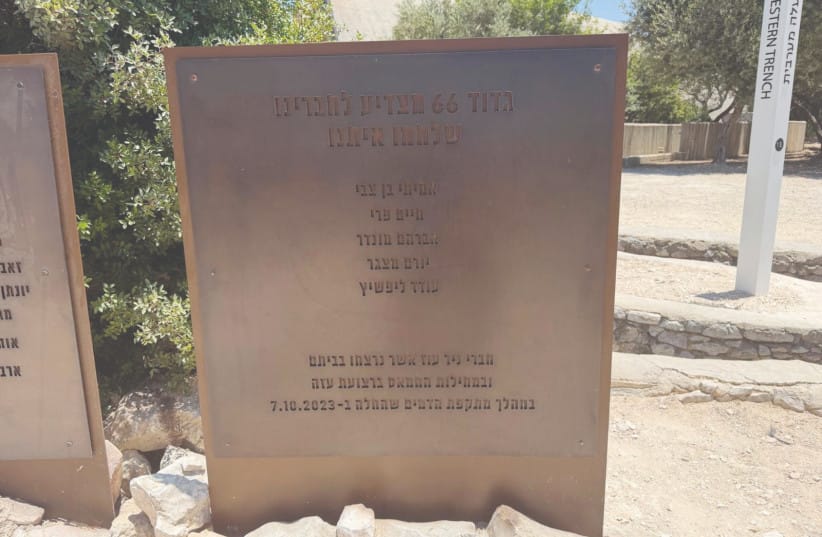
The fourth, newest addition to the monument, made of the same iron as the third section, marks a devastating moment of closure for five liberators of Jerusalem who were taken hostage and murdered by Hamas during or after the October 7 massacre.
“This closure is something that we never thought would happen, this prayer of the last page,” Wald said. “But it’s not a page, it’s a whole column.”
Amitai Yaakov Ben Zvi (80), Oded Lifshitz (83), Yoram Metzger (80), Avraham Munder (79), and Chaim Peri (79) all served in the IDF’s 66th Battalion of the Paratroopers Brigade in 1967.
Many years later, all five retired to the Gaza border community of Nir Oz, where, on October 7, Hamas massacred 47 residents of the kibbutz and took another 76 hostage, including Metzger, Peri, Munder, and Lifshitz.
Ammunition Hill tries to protect its protectors
“Realizing that they were in captivity, we [Ammunition Hill] took them off the grid,” Wald revealed to the Post. “Nobody knew. I didn’t want Hamas to realize [it was] holding living legends in case this would endanger them even more.”
“No one asked [Ammunition Hill] to do this. It was an initiative we decided to take upon ourselves. We removed them from our lists, our database, to make sure that if anybody tried to look at who [Hamas] was holding captive, they would not know,” Ammunition Hill’s chief of operations said.
He added that their names and information have since been added back into Ammunition Hill’s online archives and website.
Hamas murdered Ben Zvi in his home. His caregiver, Gelienor “Jimmy” Leano Pacheco, 34, was abducted during the massacre and later released in the November 2023 hostage deal.
Lifshitz and Metzger were both kidnapped from their Nir Oz homes alongside their wives, Yocheved Lifshitz and Tamar Metzger. Yocheved was one of the first hostages to be released by Hamas on October 23, 2023, while Tamar was released a little over a month later in November.
Oded Lifshitz was murdered in 2024 while he was being held captive by the Palestinian Islamic Jihad. His remains were returned over a year later alongside those of Kfir and Ariel Bibas and a Gaza woman whom Hamas had falsely claimed was their mother, Shiri Bibas.
Munder was kidnapped alongside his wife, Ruth, his daughter Keren, and his grandson Ohad. Hamas released all three on November 24.
His 50-year-old son, Roee, was murdered during the massacre.
Metzger and Peri’s deaths in captivity were announced by the IDF in June 2024. Two months later, in August, Nir Oz announced that Munder had also been killed in captivity.
On August 20, Metzger’s, Peri’s, and Munder’s remains were returned to Israel by the IDF.
Wald detailed the painstaking wait for the return of his heroes, men that he, the son of a fallen Six Day War paratrooper Capt. Rami Wald, grew up in the shadow of.
Peri, Metzger, and Munder, Wald said, had been candidates for Ammunition Hill’s Adopt-a-Liberator initiative.
This initiative, funded by JNF-USA, pairs Israeli high school students with Six Day War veterans in order to document their lives.
It is part of Ammunition Hill’s broader effort to create a comprehensive archive of the Battle for Jerusalem and the other war fronts of the Six Day War.
Peri, Metzger, and Munder had been slated to begin the initiative in 2023 with students from the Nofey-Habsor High School in Kibbutz Magen shortly after Sukkot.
Magen, located five kilometers from the Gaza border, was stormed by some 100 Hamas terrorists on the fateful morning of October 7.
Results of an IDF probe released in September 2024 revealed that the kibbutz’s 26-member emergency standby squads had successfully managed to repel the waves of terrorists and prevent kidnappings from taking place.
Two kibbutz residents were killed in the fighting: Avi Fleisher, a member of the security team who died from his wounds after being evacuated for medical treatment, and Ofir Mordechai Yaron, who was killed while traveling to help defend the kibbutz.
In the days following, after the magnitude of the massacre and its effects were realized, Nofey-Habsor turned to Ammunition Hill, unsure of what to do and how to proceed.
“I told them that they [Peri, Munder, and Metzger] would return, that it would be okay, that the scholarship was theirs, and that we’re not going to give up,” Wald shared.
Praying for Peri’s, Munder’s, and Metzger’s returns, the answer satisfied the school as the country held out hope for a swift end to the conflict.
However, with the IDF’s announcement of their deaths in captivity, Nofey-Habsor’s students turned back to Ammunition Hill, unsure of what to do.
“I told Eyal, who’s managing the project at Nofey-Habsor, that the scholarships were still available,” Wald said. “I told him that even though we couldn’t work with Peri, Metzger, and Munder anymore, to please adopt their families and tell the stories of these three guys through them. We need to cherish their legacy.”
Nofey-Habsor students document their would-be mentors
Since then, Nofey-Habsor students have completed short documentaries about Peri’s and Metzger’s lives and are set to begin documenting Munder’s life and legacy in the coming months.
The documentaries feature interviews with Peri and Metzger’s family members, photographs of the two men, video footage, and audio recordings.
In the film about Peri, his wife Osnat described the morning of October 7 and the moment Peri was taken by Hamas.
She explained that they had closed themselves in their shelter when the sirens started, but quickly realized that “it was something different ... a different sort of barrage.”
“We understood that we were in great danger. Haim and I agreed to seal ourselves in and stay silent. We turned off the lights, the TV, and made the difficult choice to turn off our phones.”
Terrorists had come into their house three times during the massacre.
First, the terrorists could not find the door to the shelter and instead shattered the windows and the glass back door before leaving.
“There was so much broken glass that you could hear every footstep. How many people were there?” Osnat said, recalling what was going through her mind.
Not long after, she and Peri heard another terrorist walking through their home.
This one, unlike the previous group, succeeded in finding the shelter’s door. He pried the door open only to be faced with Peri, towering in the doorway.
“Chaim grabbed him by the shoulders and threw him back,” she said. “[The terrorist] hit a wall and ran.”
Minutes later, several other terrorists entered the house again and, once more, Chaim stopped them from entering the shelter.
The terrorists spoke with him in English, telling Peri that he needed to go with them and that they would not do anything to him if he did not make trouble.
That was the moment the couple realized the terrorists did not know Osnat was there.
“Chaim, in a split second, decided to go with them, hoping that they’d leave with him and leave me alone. And it worked. They left and didn’t come back,” Osnat said.
“Everyone can learn from him: A dreamer who achieves his dreams. The biggest example of this is [Nir Oz’s] White House Gallery.”
The gallery, created from a white house that had stood abandoned for years in the fields of the kibbutz, was founded by Peri in 1999.
In the film about Metzger, his eldest granddaughter, Ofir, shared with Nofey-Habsor her grandfather’s experiences during the Six Day War and the moment her family realized both her grandparents had been kidnapped by Hamas.
Metzger had been one of the paratroopers who had accompanied former IDF chief rabbi Shlomo Goren onto the Temple Mount and down into the Western Wall Plaza at the end of the Battle for Jerusalem in 1967.
“My grandfather would always tell us about how they [the paratroopers] waited with him [Goren] to be allowed in [to the Temple Mount],” Ofir said.
“As soon as they were able to go in, the rabbi took him by the hand and walked him onto the Temple Mount,” Metzger’s granddaughter continued. “That’s how my grandfather shared that he was the first one to walk with Rabbi Goren into the Kotel Plaza.”
On October 7, Ofir said in the documentary, the moment she and her family understood that something was terribly wrong was around 7:30 a.m., when footage of armed terrorists driving through the streets of Sderot began to come out.
“The last message I got from my grandfather, after asking him again and again if everything was okay and him not answering, was kind of funny,” she recalled, “like he was trying to address the situation with humor.”
She shared a screenshot of her text thread with him. The final message sent by Metzger, after her insistence for him to keep them updated on the situation, was a text at 8:50 a.m. reading: “Just like the guy who fell from the Empire State Building said, so far so good.”
“We believe they were kidnapped at around 9:30. It was only later in the evening, when rounds were being made to make sure that no more terrorists were left in Nir Oz, that people realized their house was a mess and they were missing,” she said.
After her grandmother and other women from Nir Oz were returned in the early days of the war, including Lifshitz’s wife, they learned that Hamas would use Metzger as a translator, both to speak with other hostages and, at times, to translate Israeli television.
Being the chosen translator, Metzger had been able to garner some level of respect with his Hamas captors, and due to his knowledge of Arabic, he was able to protect other hostages by speaking to the terrorists.
“They would sometimes let him watch TV with them – not just Israeli shows, but Al Jazeera as well,” Ofir revealed. “He knew some semblance of what was going on.”
“He gave other hostages a sense of security by staying calm through it all.”
Both Hebrew-language documentaries are available to watch on Ammunition Hill’s YouTube channel.
“With the ceasefire, the battle ends, but for some, the war only begins, and that’s the bereaved families and those left behind by the fighters, of whom we say: thanks to them, we are able to live,” Muki Nin-Nun, a Six Day War veteran who fought alongside Lifshitz, Ben Zvi, Metzger, Peri, and Munder, told the Post.
“Because of them, we live by the light of their legacy. That’s how it should be said.”
Nin-Nun described how the members of the battalion continue to look after their own, meeting up once a month to catch up and remember, adding that Lifshitz, Ben Zvi, Metzger, Peri, and Munder would attend these meetings.
Metzger and Peri, he disclosed, would bring him bottles of wine from their winery in Nir Oz.
“Now, these are friends – it’s terribly hard to explain brotherhood-in-arms to someone, but it’s blood of your blood, flesh of your flesh,” he said, adding that after they were kidnapped, “the only thing we could do was shout and demonstrate every day, all day.”
“And after their bodies were returned, [the only thing we could do] was to memorialize their names at the battalion memorial site.”