
The document released on Monday, which showed that Hamas leader Yahya Sinwar believed Israel might use nuclear weapons in response to an October 7 massacre-style invasion, is nothing short of astounding.
Why? Because it reveals both Sinwar’s irrationality and Israel’s abject failure to properly understand the fanaticism driving Hamas’s leadership.
The concept of Mutual Assured Destruction (MAD), which dominated the Cold War, was based on one simple assumption: that both the United States and the Soviet Union were rational actors. If each knew the other possessed the means to destroy it, neither would dare strike first – because who, in their right mind, would invite destruction upon themselves?
Who? Actors motivated by an apocalyptic, messianic ideology for whom your destruction is more valuable than their own survival.
Evil, according to one definition, is someone who believes that his salvation can only come from your destruction. Sinwar took that one step further: Israel’s destruction was so important that he was willing to risk his own demise to bring it about.
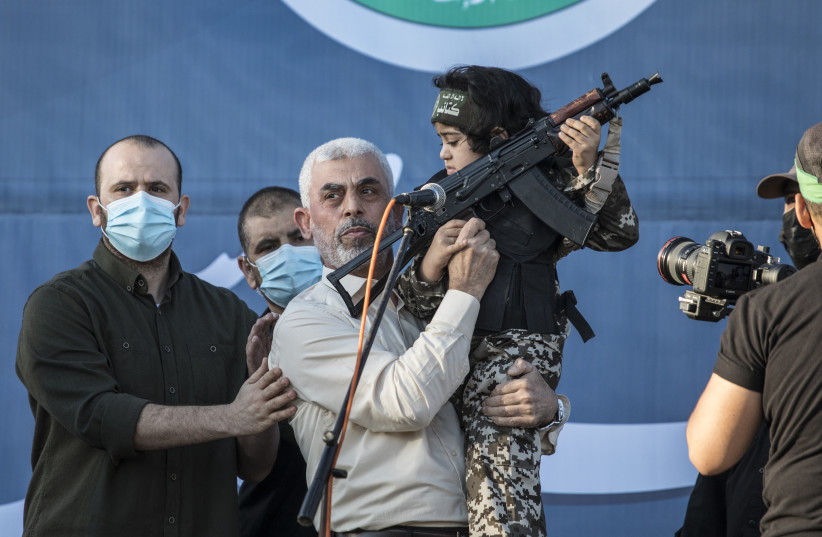
The Amit Terrorism and Intelligence Research Institute released a handwritten document by Sinwar that fell into Israel’s hands during the Israel-Hamas War in Gaza. Dated August 24, 2022 – some 13 months before October 7 – it revealed that Sinwar anticipated Israel would mount a blistering response to an invasion, and he did not rule out the possibility that it would even use nuclear weapons against Gaza.
“The enemy will not hesitate to use all the means and weapons at its disposal, not only through attack but also by other means,” Sinwar wrote. “It may even use a nuclear bomb. But first, it will be surprised by the attack and descend into chaos.”
Sinwar knew the consequences
Forget for a moment the absurdity of the claim: Nuclear fallout from a bomb dropped on Gaza would contaminate Israel as well. What matters is what this reveals about Sinwar’s mindset.
What, he didn’t realize that launching an October 7 massacre-style attack would invite a devastating Israeli response? Of course he did.
This document shows that he even contemplated the possibility of an Israeli nuclear response. Yet, even with that possibility factored in, he still went ahead with the attack.
The potential destruction of Gaza was not a deterrent for Sinwar. It was an acceptable price.
Why? Because he believed it would ignite a regional conflagration that would ultimately consume Israel.
His hope was that Hezbollah would immediately enter the war while Israel was reeling in chaos; that Iran would rain ballistic missiles down on the country; that the Houthis would attack from Yemen; that the West Bank would erupt; and that Arab Israelis would again rise up, as some did during Operation Guardian of the Walls in 2021.
Even massive devastation in Gaza, he reasoned, would be worth triggering a regional war that would bury Israel.
His salvation would come through Israel’s destruction. Pure evil.
Seen through the prism of this document, the notion that Hamas could be pacified with suitcases of Qatari cash or thousands of work permits for Gazan laborers was sheer folly. It reflected a fundamental misreading of the enemy.
Those policies assumed Hamas’s leaders could be persuaded to choose economic well-being over the destruction of Israel. But this document suggests that Sinwar was motivated by something different altogether. He was prepared to risk not only Gaza’s prosperity, but Gaza’s very existence, if that was the price of destroying Israel.
One of Israel’s major mistakes in assessing Sinwar and Hamas was viewing them through our own prism – looking at them as though we were looking in a mirror.
We assumed they would think as we would. Who would knowingly invite that level of destruction upon themselves? We would never do that. So, we assumed they wouldn’t, either. But now we have Sinwar’s own words showing us that even the prospect of nuclear devastation did not deter him.
There are obvious parallels to Osama bin Laden’s attack on the United States on September 11, 2001.
Bin Laden, too, understood that the attacks would provoke a massive American military response. But that was not a disincentive. On the contrary, he hoped that the American reaction would ignite a wider civilizational war between Islam and the West.
The implications of the Sinwar document extend far beyond Gaza.
Hamas willed mutual destruction; other Islamist regimes may make same sacrifice
If, in pursuit of a messianic religious ideology, Hamas’s leader was willing to sacrifice Gaza in order to destroy Israel – rendering Mutual Assured Destruction irrelevant – then the same could be true of other fanatical actors in the region, including Iran.
US President Donald Trump said earlier this month that Iran must never be allowed to obtain nuclear weapons, because if it did, it would use them.
Iran’s apologists scoff at that argument. Of course they wouldn’t, they say. They know that if they used nuclear weapons, they, too, would be destroyed.
The Sinwar document suggests otherwise. It shows that at least some of the religious fanatics Israel is confronting may view their own destruction as an acceptable price if it advances what they believe to be a divinely ordained mission.
And that brings us back to the definition of evil: someone believing that his salvation can only come through your destruction.
Sinwar’s admission provides a rare peephole into that mindset, one shared by some of Israel’s implacable enemies. Now, Israel needs to make sure the rest of the world looks through that peephole as well.